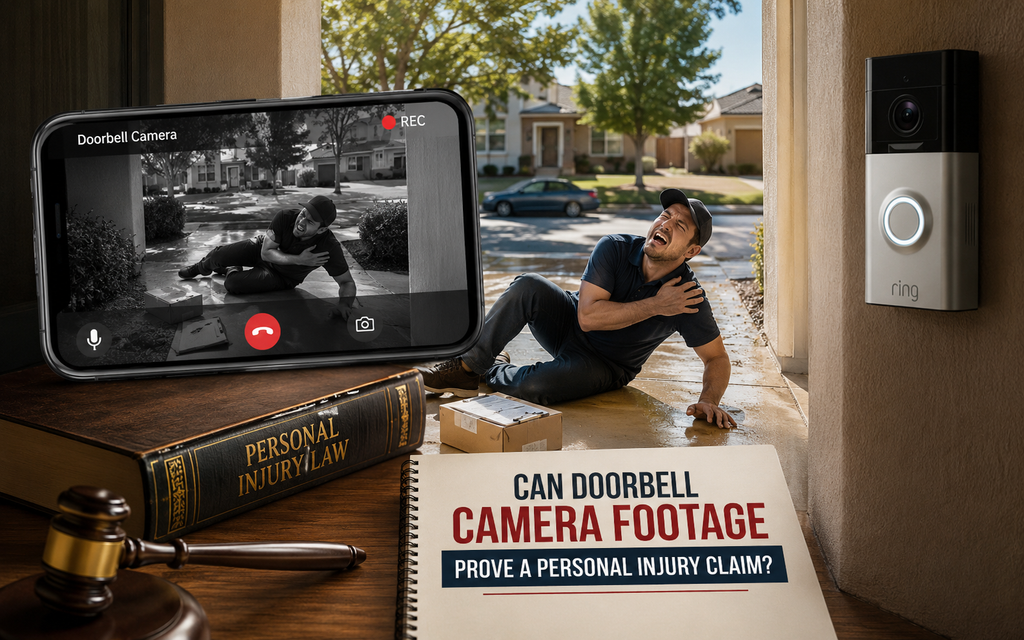
Yes. Doorbell camera footage can be powerful evidence in a personal injury claim, particularly when it captures the accident itself, the events leading up to it, or a dangerous condition that contributed to an injury.
A residential doorbell camera might record a car running a stop sign, a pedestrian being struck, a person slipping on an icy sidewalk, a dog escaping from a property, or a hazardous condition outside a home. Unlike eyewitness accounts, video provides a visual record that does not depend on a person’s memory of an event. Surveillance footage can help establish how an accident happened, identify potentially responsible parties, document a dangerous condition, and confirm the sequence of events.
However, video footage is not automatically conclusive proof of an entire personal injury claim. The camera may capture only part of an accident, the image quality may be poor, or important events may occur outside the camera’s field of view. The footage must also be properly preserved, obtained, authenticated, and considered alongside other evidence.
When available, though, a doorbell camera can become one of the most valuable independent sources of evidence in a disputed accident.
Why Is Doorbell Camera Footage So Valuable?
Many personal injury cases involve competing accounts of what happened.
One driver may insist another vehicle entered the intersection first. A property owner may argue that no dangerous condition existed. A dog owner may dispute how an animal escaped. Witnesses might remember the same event differently.
Doorbell footage can sometimes resolve those disputes by showing the incident as it actually unfolded.
Surveillance video can help answer questions such as:
- Where were the people or vehicles immediately before the accident?
- Who had the right of way?
- Was a driver speeding or driving aggressively?
- Did someone fail to stop before entering an intersection?
- Was a sidewalk covered in snow or ice?
- Was an object obstructing a walkway?
- How long had a dangerous condition been present?
- Were warnings or barriers visible?
- Did a dog escape from an unsecured property?
What did the injured person do immediately before and after the accident?
Doorbell cameras are particularly useful because they frequently record areas beyond the homeowner’s front porch, including sidewalks, streets, driveways, neighboring properties, parking areas, and intersections. Footage from a nearby residence can therefore capture an accident even when the homeowner had no involvement in it.
What Types of Personal Injury Claims Can Doorbell Cameras Help Prove?
Doorbell video can potentially become relevant in many types of accident cases.
Car Accidents
A doorbell camera facing a residential street may capture a collision or events immediately before it.
Depending on the camera angle, footage could show:
- A vehicle running a stop sign
- An unsafe turn
- Excessive speed
- A driver crossing the centerline
- A rear-end collision
- A vehicle backing from a driveway
- A hit-and-run driver leaving the scene
- Traffic conditions immediately before the crash
This evidence can be especially useful when there are no independent eyewitnesses or when the drivers provide conflicting accounts.
Residential cameras near intersections, driveways, sidewalks, and neighborhood streets may capture vehicle, bicycle, pedestrian, dog-attack, and hit-and-run incidents that would otherwise have no video record.
Pedestrian and Bicycle Accidents
Doorbell cameras may also capture crashes involving pedestrians or cyclists.
A recording might establish whether a pedestrian was already crossing the roadway, whether a cyclist had the right of way, how quickly a vehicle approached, or whether the driver stopped after the collision.
The moments before an impact can sometimes be just as important as the collision itself because they may reveal how each person was behaving.
Slip and Fall Accidents
Doorbell cameras can be particularly valuable in premises liability cases involving outdoor hazards.
For example, footage might show:
- Snow or ice accumulating on a walkway
- A broken step
- Debris blocking a path
- Poorly maintained stairs
- An uneven walking surface
- Water accumulating near an entrance
- An object creating a tripping hazard
The camera may also reveal how long a condition existed before the accident.
That timeline can become important because premises liability often involves questions about whether a property owner knew or reasonably should have known that a dangerous condition existed and whether there was sufficient time to address it. Video may document both the hazard and what occurred around it before the accident.
Dog Bites and Animal Attacks
A doorbell camera may capture a dog escaping from a house, yard, gate, or leash before an attack.
The video could potentially show:
- Whether a gate was open or broken
- Whether the dog was restrained
- How the animal approached the injured person
- Whether anyone attempted to control the dog
- What occurred immediately before the attack
Depending on the applicable law, this information may help clarify disputed facts surrounding the incident.
Delivery and Residential Property Accidents
Doorbell cameras frequently record delivery drivers, contractors, visitors, and others approaching residential properties.
That means they may document falls on stairs, porch accidents, walkway hazards, falling objects, or other incidents involving people entering or leaving a property.
Can Doorbell Footage Show Who Was at Fault?
Sometimes.
One of the strongest uses of video evidence is establishing liability, or who was legally responsible for causing an accident.
For example, footage might clearly show one vehicle passing through a stop sign without slowing before striking another car. In another case, the recording might show that an icy walkway had remained untreated for an extended period while people associated with the property repeatedly passed nearby.
Video evidence can reduce reliance on competing recollections and provide insurers, attorneys, judges, or jurors with an opportunity to evaluate what actually happened.
But the footage must still be interpreted in the context of the applicable law.
A video may show what happened without necessarily answering every legal question. Liability can still depend on issues such as right-of-way rules, property-owner obligations, comparative negligence, notice of a dangerous condition, or other jurisdiction-specific standards.
Can Doorbell Footage Help Prove an Injury?
It can provide supporting evidence, particularly when the camera captures the accident and its immediate aftermath.
For example, footage might show:
- The force of a collision
- A person falling violently to the ground
- Difficulty standing or walking afterward
- A person holding an injured body part
- Emergency personnel arriving
- An injured person being transported from the scene
These observations may help corroborate a person’s account of how an injury occurred.
However, a doorbell recording generally cannot establish the complete nature or medical cause of an injury by itself. Medical records, diagnostic imaging, treatment documentation, physician opinions, and other evidence may still be necessary to connect the accident to a particular medical condition and establish the extent of damages.
In other words, doorbell footage may be exceptionally strong evidence of how an injury-producing event happened, while medical evidence typically plays a major role in establishing what physical harm resulted.
What If the Camera Did Not Capture the Actual Accident?
The footage may still be useful.
Video recorded before or after an accident can provide important contextual evidence.
For example, a camera might show:
- A dangerous condition developing before a fall
- Snow or ice remaining untreated
- A vehicle traveling down the street immediately before a collision
- A dog repeatedly escaping through the same broken fence
- The parties’ actions immediately after an accident
- Someone repairing or removing a hazardous condition shortly afterward
- Emergency responders arriving at the scene
A recording therefore does not necessarily need to show the exact moment of impact to have evidentiary value.
Doorbell Camera Footage Can Confirm the Timeline
Timing can be critical in a personal injury case.
A doorbell camera may record when an incident occurred and provide a chronological record of events around it.
In a premises liability case, for example, several hours of footage could potentially show when snow began accumulating, when a hazardous object appeared, or whether anyone inspected the area before the accident.
Surveillance footage can help establish not only when an accident occurred but also how long a dangerous condition existed and what took place immediately before and afterward.
That timeline may be much more informative than a single photograph taken after the accident.
What If a Neighbor’s Doorbell Camera Recorded the Accident?
The most useful camera does not have to belong to the injured person or the person accused of causing the accident.
A neighbor’s camera may have captured the entire incident from across the street.
Potential sources of residential footage can include cameras mounted on:
- Nearby houses
- Apartment buildings
- Condominiums
- Garages
- Driveways
- Gates
- Side entrances
- Neighboring businesses
After an accident, identifying nearby cameras can therefore be an important part of investigating what happened.
A homeowner may not even realize that their camera captured an accident until someone asks them to review the recording.
Why Doorbell Footage Needs to Be Preserved Quickly
One of the biggest problems with digital video is that it may not remain available indefinitely.
Depending on the device, subscription, storage settings, or user preferences, recordings may eventually be deleted, overwritten, or become inaccessible. Surveillance systems commonly retain footage only for limited periods, making prompt investigation important.
If potentially important footage exists, common preservation steps can include downloading the original recording and securely storing copies before it disappears.
When the footage belongs to someone else, a written preservation request may sometimes be appropriate. If litigation is reasonably anticipated, preserving relevant electronically stored information can also implicate legal preservation duties. Federal Rule of Civil Procedure 37(e), for example, addresses electronically stored information that should have been preserved in anticipation or conduct of litigation but is lost because reasonable preservation steps were not taken.
The precise preservation obligations and remedies for lost evidence vary by jurisdiction and circumstances.
What Is a Preservation Letter?
A preservation letter, sometimes called a spoliation notice, is a formal communication requesting that potentially relevant evidence not be destroyed, erased, altered, or overwritten.
In a case involving doorbell footage, a preservation request might identify:
- The date of the accident
- The approximate time
- The location
- The relevant camera
- The period of video that should be retained
Related photographs, audio, metadata, or other electronic information
Prompt preservation requests can be especially important because digital surveillance systems may routinely delete older recordings as part of their normal operation.
Preserving a longer time window surrounding the incident may also be useful rather than saving only a short clip of the actual accident.
Why the Original Video File Matters
When possible, maintaining the original recording can help preserve information about the file and reduce later disputes over whether it was modified.
Rather than relying exclusively on a cellphone recording of a video playing on another screen, it may be preferable to obtain the actual exported digital file generated by the camera system.
It can also be wise to avoid unnecessarily:
- Editing the video
- Cropping the recording
- Applying filters
- Changing playback speed
- Adding text or graphics
- Overwriting the original file
Copies can be created for viewing or presentation, but maintaining an untouched original can help establish the integrity of the evidence.
Does Doorbell Camera Footage Have to Be Authenticated?
Generally, evidence offered in court must satisfy applicable rules governing authenticity and admissibility.
Under Federal Rule of Evidence 901, a party seeking to introduce an item must produce sufficient evidence to support a finding that the item is what the party claims it is. The rule identifies several possible methods of authentication, including testimony from a witness with knowledge and evidence concerning a process or system that produces an accurate result.
With doorbell footage, authentication might involve evidence concerning:
- Who owns or controls the camera
- Where the camera was located
- How the recording system operates
- When the video was recorded
- How the file was downloaded
- Whether the recording fairly depicts the relevant location or event
- Whether the file has been altered
The exact requirements depend on the jurisdiction and circumstances.
This is one reason simply possessing a video is not necessarily the same as having evidence that can automatically be admitted in court.
What About the Audio Recorded by a Doorbell Camera?
Some doorbell systems record audio as well as video.
Audio may capture potentially relevant statements, noises, warnings, or other information. However, audio-recording and privacy laws vary significantly among states.
Whether a particular recording was legally obtained and whether its audio can be admitted or used may therefore require a separate legal analysis.
The existence of useful video does not necessarily mean every component of the recording will be admissible.
Can Doorbell Camera Footage Hurt a Personal Injury Claim?
Yes.
Video evidence is objective in the sense that it records what is within the camera’s field of view, and that evidence can support either side.
For example, footage could show that:
- The injured person entered the roadway unexpectedly
- A pedestrian was distracted
- A warning sign was clearly visible
- The alleged hazard did not exist
- A claimant appeared to be moving differently than described
- Another person or event contributed to the accident
For that reason, video should be reviewed carefully in its entirety rather than assuming that its existence automatically favors one side.
Footage that contradicts a claimant’s version of events may weaken a case just as substantially as favorable footage can strengthen one.
Is Doorbell Footage Enough to Win a Personal Injury Claim?
Potentially powerful? Yes.
Automatically sufficient? No.
A successful personal injury claim generally involves establishing more than simply proving that an accident occurred. Depending on the claim, the injured person may need evidence addressing:
- Duty of care
- Breach of that duty
- Causation
- Injury
- Economic and non-economic damages
A doorbell camera may provide compelling evidence of the accident itself and help establish negligence. Other evidence may still be required to complete the picture.
That evidence could include:
- Police or incident reports
- Witness statements
- Photographs
- Medical records
- Diagnostic imaging
- Medical opinions
- Vehicle data
- Property inspection records
- Maintenance records
- Expert testimony
The strongest case may therefore combine objective video footage with medical, documentary, physical, and testimonial evidence.
What Should Someone Do If They Believe Doorbell Footage Exists?
Time can be important when seeking digital recordings.
After an accident, reasonable investigative steps may include:
1. Look around the accident scene for cameras. Nearby homes, apartments, businesses, gates, and garages may have recording devices.
2. Document the camera locations. Photographs of visible cameras can help identify potential sources later.
3. Determine the relevant time period. Footage from before and after the accident may be just as valuable as the moment of the incident itself.
4. Request preservation promptly. Waiting may increase the chance that a recording is automatically deleted or overwritten.
5. Preserve the original file when possible. Maintain an unedited copy along with any available identifying information.
6. Avoid altering the footage. Editing can create unnecessary disputes regarding completeness or authenticity.
7. Consider whether additional cameras exist. A second angle from another residence or business may reveal information the first camera missed.
Because surveillance footage can disappear quickly, delaying an investigation may mean losing an important source of evidence permanently.
The Bottom Line: Doorbell Cameras Can Provide Powerful Evidence After an Accident
Doorbell camera footage can strongly support—and in some cases may provide key proof in—a personal injury claim by creating an objective visual record of what happened.
It can show how a car accident occurred, document the presence and duration of a property hazard, capture a dog attack, confirm a timeline, identify witnesses or vehicles, and contradict inaccurate accounts of an incident.
But a recording is rarely a standalone guarantee of liability or compensation. Its usefulness depends on what the camera actually captured, how clearly it depicts the relevant events, whether the footage is preserved in time, whether its authenticity can be established, and how it fits with the other evidence in the case.
For anyone involved in a serious accident, one of the most important questions to ask early in the investigation may be surprisingly simple:
Was there a camera nearby?
The answer could provide an objective record of an event that otherwise would depend entirely on competing memories.
This article provides general information about doorbell camera and surveillance evidence in personal injury claims and is not legal advice. Evidence preservation, privacy, authentication, admissibility, and personal injury laws vary by jurisdiction and the circumstances of each case.