• Home
  • Top News
  • Local
  • World
  • Health
  • Business
  • Home
  • Top News
  • Local
  • World
  • Health
  • Business
World

New Telescopes Are Finding Worlds Worth a Second Look

Daniel Alvarez
Last updated: October 21, 2026 6:46 am
By Daniel Alvarez
Share
5 Min Read
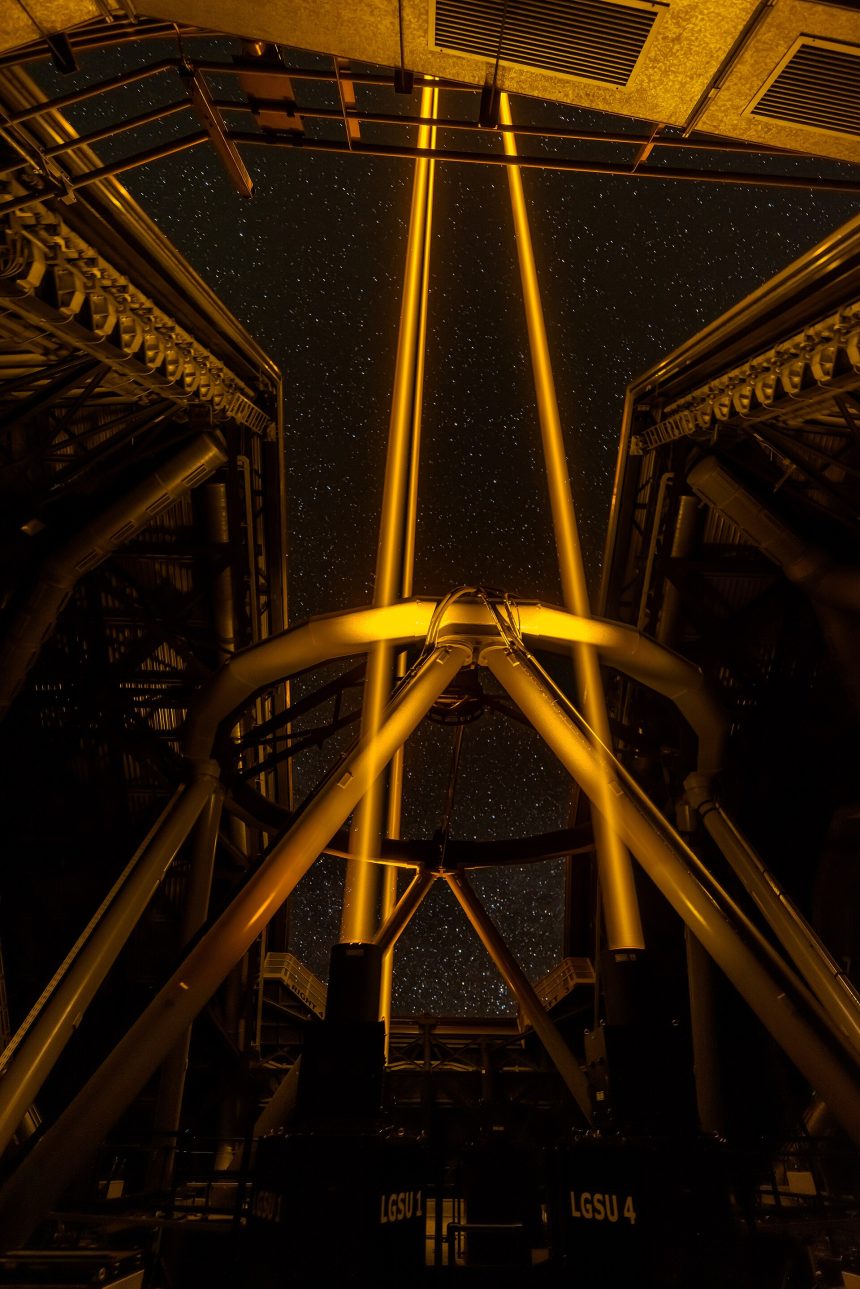
A telescope silhouetted against a star-filled night sky at an observatory
With advanced instruments designed to catch the light from extrasolar worlds and the universe’s most distant stars and galaxies, crystal clear images are a must. To achieve this, the Unit Telescope 4 Yepun of ESO’s Very Large Telescope (VLT) in Chile has an adaptive optics facility equipped with four sodium lasers, aimed towards the sky. When the laser beams reach about 90 kilometers into the atmosphere, they excite sodium atoms that start to glow, creating artificial stars in the sky. By monitoring how these artificial stars twinkle, the deformable secondary mirror of the telescope reshapes at milli-second speeds, correcting atmospheric turbulence. But the Milky Way already has several billions of stars, so why would we need some more and how will that help to create clearer images, you might wonder? Adaptive optics requires having a relatively  bright reference star close in the sky to the object you want to observe, but that’s not always the case, hence the need for artificial laser stars. PS. Did you know that sodium is the element usually found in older street lamps? It is the two resonance lines of sodium that creates the recognisable intense orange colour as seen in the above image from the VLT.
SHARE

When the first planets beyond our solar system were confirmed in the 1990s, the discovery itself was the sensation. Three decades later, astronomers have catalogued well over five thousand exoplanets, and the field has entered a richer phase: not just finding worlds, but reading them. Using telescopes that can separate a planet’s faint light from its star’s glare, or catch the whisper of starlight filtered through a planet’s atmosphere as it transits, scientists are beginning to inventory the chemistry of places dozens or hundreds of light-years away. Some of those inventories contain water vapour, clouds and hints of far stranger weather.

Contents
From census to characterisationThe biosignature problemWhy distant worlds matter here

The shift is powered by instruments such as the James Webb Space Telescope and a new generation of ground-based observatories, with mission science summarised by NASA’s exoplanet programme. For valley readers who look up from light-polluted streets and wonder what is out there, the honest answer has changed in a generation: quite a lot, and increasingly, we can describe it. More science stories are gathered on our homepage.

From census to characterisation

The workhorse methods remain ingenious. Transit photometry watches for the tiny dip in brightness when a planet crosses its star; radial velocity measurements track the star’s wobble under a planet’s gravitational tug. Together they yield a planet’s size, mass and orbit, and from those, its density, which separates rocky worlds from gas giants and watery in-betweeners. The new step is spectroscopy: spreading the light into a spectrum and looking for the absorption fingerprints of molecules in an atmosphere.

That is how researchers have reported carbon dioxide, methane and sulphur compounds in the skies of hot gas giants, and how they are now probing smaller, cooler worlds in the habitable zone, where liquid water could persist on a rocky surface. Each detection is hard-won, built from many transits stacked together, and each carries caveats that careful scientists state plainly. The coming decade’s dedicated missions aim to do for dozens of temperate worlds what is now done laboriously for a handful, including the targets catalogued at NASA’s universe pages.

The biosignature problem

Eventually the characterisation project runs into its deepest question: could any of these measurements amount to evidence of life? Certain gas combinations, oxygen alongside methane, for instance, are difficult to sustain without biology continually replenishing them. But difficult is not impossible, and the history of the field includes celebrated claims that dissolved under scrutiny. The community’s emerging standard is therefore cautious: a candidate biosignature must survive attempts to explain it with geology, chemistry and instrument error before it earns serious attention.

That discipline is a strength, not a failure of nerve. When a claim of life’s detection finally comes, if it comes, it will need to be unshakeable, because it would be the most consequential scientific announcement ever made. In the meantime, the intermediate discoveries reward patience on their own terms: planets with lava hemispheres, worlds with metal clouds and rains of glass blown sideways, systems packed tighter than anything our solar system attempted.

Why distant worlds matter here

Exoplanet science quietly reframes our own planet. Every atmosphere read at interstellar distance sharpens the models used to understand Earth’s climate and history, and every system surveyed adds context to the question of how typical our arrangement, a calm star, a temperate rocky world, a large stabilising moon, really is. The emerging answer seems to be that planets are common and variety is endless, while exact analogues of home remain, so far, unconfirmed.

For now the telescopes keep their patient watch, transit by transit, photon by photon. Our science coverage returns to these worlds as new spectra are published, because each one is a small act of long-distance exploration: nobody alive will travel to them, yet increasingly, we can say what their skies are made of. That is a remarkable sentence to be able to write, and it gets truer every year.


TAGGED:AstronomyExoplanetshabitable worldsspace telescopes
Share This Article
Facebook Twitter Copy Link Print
Leave a comment Leave a comment

Leave a Reply Cancel reply

Your email address will not be published. Required fields are marked *

Search

Recent Posts

A semiconductor fabrication plant in Senawang, Malaysia, part of the global chip supply chain
The Global Chip Race Enters Its Expensive Phase
Business
Man sleeping with framed picture
Can You Catch Up on Sleep at the Weekend? The Evidence Is Rude
Health
Euclid’s view of the Horsehead Nebula ESA25170866
Alien Life Headlines: A Citizen’s Guide to Biosignature Claims
Top News
Scientist examining samples through a microscope in a laboratory
Blood Test May Spot Crohn’s Disease Years Before Symptoms
Health
School students eating lunch with fruit in a cafeteria
One Extra Serve of Fruit a Day Linked to Calmer Teen Minds
Health
A modern business centre tower in Bishkek, Kyrgyzstan
Data Borders Take Shape Across Central Asia After Platform Shocks
World

You Might Also Like

Gunman Settling a Grudge Kills 5, Injures 2 at Bangkok Market Before Taking Own Life, Police Report
World

Gunman Settling a Grudge Kills 5, Injures 2 at Bangkok Market Before Taking Own Life, Police Report

By Aarti Bhalla
Turkey’s fourth-largest city faces threat as wildfires rage across southern Europe
World

Turkey’s fourth-largest city faces threat as wildfires rage across southern Europe

By Aarti Bhalla
Kyiv Targeted by Wave of Drone Strikes as Putin Dismisses Trump’s Call for Truce
World

Kyiv Targeted by Wave of Drone Strikes as Putin Dismisses Trump’s Call for Truce

By Aarti Bhalla
Malaysia Announces Thailand and Cambodia Agree to ‘Immediate, Unconditional’ Ceasefire
World

Malaysia Announces Thailand and Cambodia Agree to ‘Immediate, Unconditional’ Ceasefire

By Aarti Bhalla

ValleyVistaNews delivers inspiring stories, uplifting news, and insightful updates, keeping you informed and motivated with positive content.

Bringing light to everyday moments, celebrating achievements, and sharing the good happening around the world. #ValleyVistaNews

Popular Posts
The Global Chip Race Enters Its Expensive Phase
October 21, 2026
New Telescopes Are Finding Worlds Worth a Second Look
October 21, 2026
Can You Catch Up on Sleep at the Weekend? The Evidence Is Rude
October 20, 2026
Contact Us

ValleyVistaNews values your feedback and inquiries. Whether sharing a news tip, exploring advertising, or seeking support, reach out anytime.

Email: contact@outreachmedia .io
Phone: +92 305 5631208

Address: 2862 Keyser Ridge Road
Greensboro, NC 27401

สล็อตวอเลท | สล็อตเว็บตรง | สล็อตเว็บตรง | สล็อตเว็บตรง | สล็อตเว็บตรง | สล็อตเว็บตรง | สล็อตเว็บตรง | ยูฟ่าเบท | UFABET |ยูฟ่าเบท365 |UFABET เข้าสู่ระบบ | บาคาร่า | go88 | sunwin | sunwin | ufa | หวย

Copyright © 2026 | All Right Reserved | ValleyVistaNews

  • About Us
  • Contact Us
  • Disclaimer
  • Privacy Policy
  • Terms and Conditions
  • Write for Us
  • Sitemap

WhatsApp us

Welcome Back!

Sign in to your account

Lost your password?