The market for wrist-worn health devices has expanded rapidly, and the choices can feel overwhelming. Not every device marketed with cardiac imagery delivers the same depth of insight. Comparing them thoughtfully, before committing, helps ensure the chosen companion actually supports the kind of ongoing health awareness that is wanted. A few clear principles make the comparison far more manageable.
Accuracy matters. Optical sensors should be reliable across skin tones and movement, and any blood pressure measurement should be built on a properly calibrated mechanical approach rather than a vague estimate. Comfort matters too, because a device that comes off the wrist by midday is a device that collects no data. Ecosystem matters: the companion app should present trends clearly, work with the phone already in use, and avoid locking data into a walled garden. Finally, depth matters: does the device offer only pulse counting, or does it add ECG, heart rate variability, sleep staging, blood pressure and a readiness score?
It is also worth considering how the device will actually be used. A person focused on morning walks may value GPS and pace above all; someone managing long-term blood pressure will prioritise cuff-based measurement and ambulatory reports. An older adult living independently may place family sharing and simplicity at the top of the list. There is no single best device for everyone, and the most feature-rich option is rarely the right one if half the features go unused.
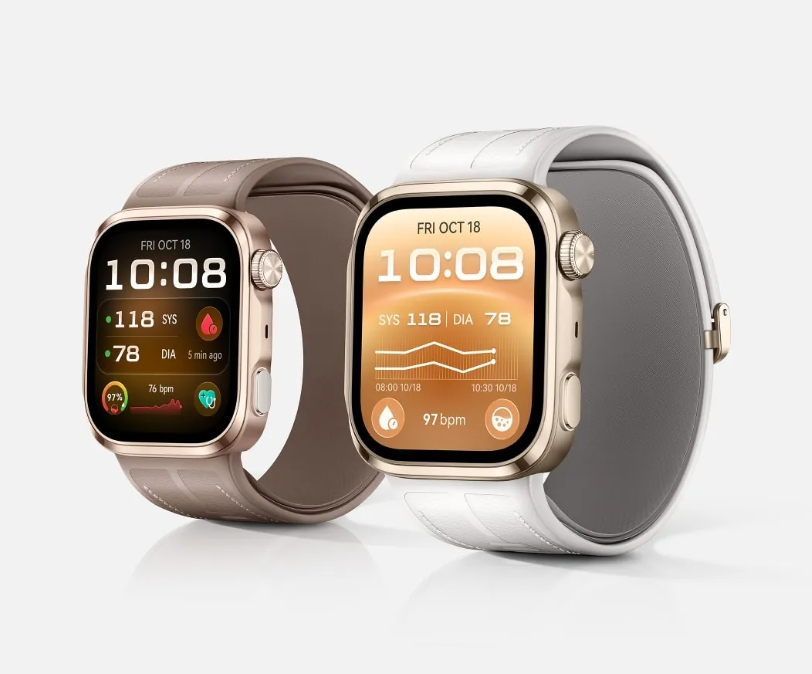
Among the growing range of watches for heart monitoring, the most useful devices are those that combine continuous sensing with a comfortable profile for all-day wear. A slim case, a soft strap and a bright screen make it possible to wear the device through work, exercise and sleep without conscious effort. When the same wrist can run a short ECG recording, track blood pressure on demand and support a twenty-four-hour ambulatory monitoring plan, it becomes a compact cardiovascular companion rather than a simple pedometer. Readers who want the underlying clinical reasoning behind such features will find a thoughtful, evidence-based discussion of what exercise and blood pressure readings reveal about effort and recovery.
It is also worth thinking about how the device fits into wider care. Some wearables support sharing summaries with family members or clinical teams, which can be especially valuable for older adults or people managing chronic conditions. Others place more emphasis on sports metrics. Matching the device to the actual priorities of the wearer is more important than choosing the most feature-rich option available, because the device that disappears into daily life is the one that will actually gather the data.
A heart monitoring watch is a long-term companion. Choosing one that is comfortable, accurate and easy to interpret is the single biggest factor in whether it will still be on the wrist a year from now, quietly accumulating the data that makes ongoing insight possible. The cheapest or most heavily marketed option is not necessarily the wisest; the one that matches the wearer’s daily routine and genuine priorities is.
Battery life is a habit feature, not a luxury. A watch that needs charging every night will be off the wrist for a portion of every evening and every morning — precisely the hours when overnight heart rate, sleep staging and morning blood pressure are most useful. Devices that comfortably last several days on a charge, or that top up quickly during an evening shower, remove the single most common reason for gaps in the data. For a tool that depends on continuous wear, this is one of the most practical specifications on the list.
Data ownership and privacy are worth understanding before purchase. Reputable manufacturers give wearers control over what is recorded, what is backed up, and who it is shared with. The companion app should make it easy to export personal data and to delete it when that is preferred. Because the information in question is genuinely sensitive, a device that treats privacy as a feature rather than an afterthought is a better long-term partner than one whose marketing is louder but whose practices are vague.
It is also worth trying the device on if possible. The shape of a case, the feel of a crown, the weight on the wrist and the legibility of the screen in daylight are all things that a specification sheet cannot convey. A device that looks perfect on paper but feels wrong on the arm will not be worn consistently, no matter how many features it has. Comfort and usability, in the end, are the most important specifications of all.
Choosing a heart monitoring watch is, in the end, about choosing a long-term companion. Accuracy, comfort, depth of insight and privacy are the features that matter most, because they are the features that determine whether the device is still on the wrist, quietly gathering useful data, a year from now.